
The Trust Deficit: 5 Surprising Reasons Gen Z and Alpha are Reimagining Authority

Published 4/5/2026
For decades, the professional world was anchored by a stable, if unexamined, social contract: institutional hierarchy was absolute, and personal loyalty was rewarded with a slow, steady climb up the corporate ladder. Today, that contract has not merely been amended; it has been shredded. As Gen Z enters a workplace fundamentally reshaped by the pandemic, the "Me Too" movement, and systemic global crises, they are bringing with them a profound crisis of institutional legitimacy.
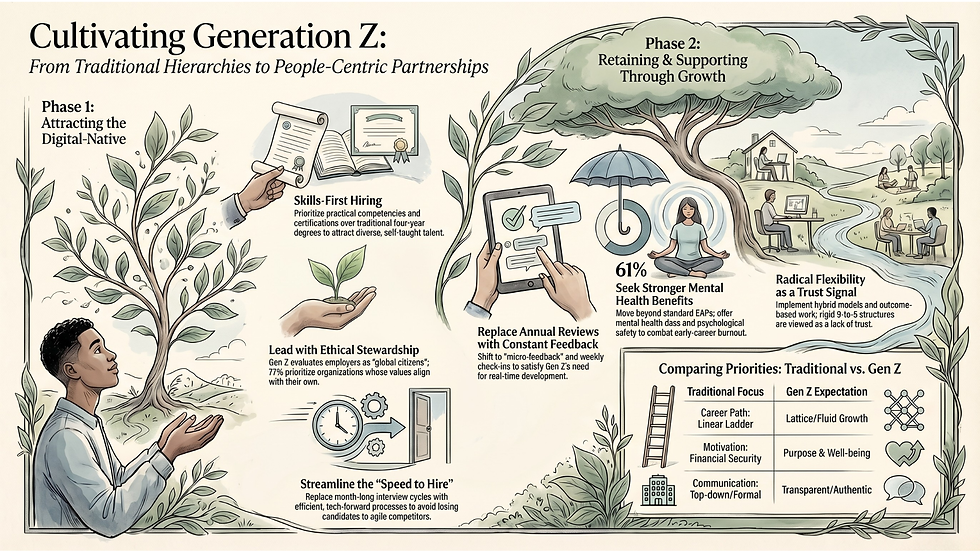
The traditional "climb the ladder" mentality is now viewed as an antiquated structure. We are witnessing the end of "because I said so" management. The youngest two generations in the workforce—Gen Z and the emerging Gen Alpha—are not inherently "difficult" or "disloyal." Rather, they are reacting to a history of institutional instability with a healthy, data-backed skepticism of authority. To lead them, organizations must move beyond the title and understand the sociological shifts reimagining the nature of power.

The Leadership Paradox: Why the Corner Office Lost Its Luster
One of the most striking findings in modern organizational data is the plummeting desire for traditional leadership roles. The scale of this shift is documented in Deloitte’s 2025 Global Gen Z and Millennial Survey, which queried 23,482 respondents across 44 countries. The results are startling: only 6% of Gen Z see reaching a leadership position as a primary career goal.
This is not a deficit of ambition, but a calculated rejection of the current leadership model. Younger workers increasingly associate management with chronic burnout and a lack of meaningful development. They have spent their formative years watching older colleagues struggle under the weight of "always-on" cultures, leading to a profound disengagement from the traditional rewards of the hierarchy. As noted in the Deloitte and Thomas.co synthesis:
"Perhaps watching older colleagues struggle with burnout and a lack of meaningful development is making them question whether the opportunities they seek will truly materialize. A context that understandably fuels disengagement."
The Ethics Filter: When Values Outrank the Paycheck
Gen Z is the first generation to treat corporate ethics as a non-negotiable filter for employment, drawing a definitive "line in the sand." Data from SHRM and Thomas.co reveal that for these professionals, purpose is a more potent motivator than a salary:
74% of Gen Z workers rank purpose at work as more important than a paycheck.
50% of Gen Z have rejected specific assignments based on their personal beliefs or ethical frameworks.
This shift recalibrates the definition of "Quiet Quitting." Sociologically, this behavior is rarely about a lack of work ethic; it is a response to a mismatch in values. According to Wellhub research, a toxic work culture is 10 times more powerful than compensation in predicting turnover. When an institution’s actions contradict its stated ethics, younger workers withhold their discretionary energy, viewing the lack of purpose as a literal toxic stressor that no salary increase can remediate.
The "Digital Native" Misconception: The Defense Against Filtered Communication
While Gen Z and Alpha are labeled "digital natives," their communication preferences reveal a sophisticated defense mechanism against institutional spin. A 2023 Udemy survey highlights a counter-intuitive trend: 58% of Gen Z prefer face-to-face communication over digital channels at work.
This preference stems from a deep-seated mistrust of "filtered" institutional communication. Digital platforms allow organizations to curate and sanitize messages, whereas direct, human interaction provides the transparency and real-time accountability these generations crave. However, this demand for connection faces a psychological trap. As noted by BeHealthy Counseling, the "us vs. them" mentality can be unintentionally triggered by "social silos"—even through well-intended identity-focused commemorations—which can deepen intergroup bias and social fragmentation. Leaders must bridge this by fostering shared values rather than segmented narratives.
The Vulnerability Requirement: Navigating the "Dark Side" of Power
In the traditional hierarchy, leaders projected an image of infallible authority. However, modern sociological research into "dark side" leadership traits suggests a more complex reality. While "Narcissistic Leadership" (characterized by grandiosity and devaluing others) remains a primary driver of organizational failure, research by Khoo & Burch (2008) offers a surprising nuance: while "Bold" (narcissistic) traits are negative predictors, the "Colorful" (histrionic) dimension—marked by expressiveness and high-energy engagement—is actually a positive predictor of transformational leadership.
Gen Z craves this "Authentic" leadership—leaders who are self-aware and responsive to feedback. They are particularly wary of the "power-blindness" described by Sarah Milstein (LeadDev), where leaders stop seeing bad behavior as they gain status:
"As I gained power, [harassers] tended to hide their actions from me and my peers—that is, from the very people with the ability to do something... just as we are able to meaningfully address bad behavior at work, we tend to stop seeing it."
To earn trust in the "Leader-Member Exchange" (LMX), authority figures must model vulnerability, sharing mistakes and uncertainties to prove they are humans, not just titles.
The "Action or It Didn't Happen" Rule: The High Cost of Performance Surveys
Many institutions attempt to measure culture through frequent pulse surveys, but failing to take visible action after gathering data breeds deep cynicism. Research from Mind Share Partners indicates that U.S. workers are currently working at only 71% of their full capability due to mental health challenges and workplace stressors.
When an organization collects feedback on sensitive topics but maintains the status quo, it signals that employee experiences are secondary to institutional convenience. In the eyes of Gen Z and Alpha, feedback without action isn't a strategy—it’s a performance. Institutional accountability is the only antidote to "competitive victimhood" and the social fragmentation that erodes a team's collective output.
Conclusion: Toward a New Social Contract
The reimagining of authority by Gen Z and Alpha is a fundamental shift in the social contract. Authority is no longer a birthright granted by a title; it must be earned through transparency, psychological flexibility, and consistent, visible action.
As we look toward Gen Alpha, early research suggests they will be even more direct, tech-first, and entrepreneurial. The institutions that survive this shift will be those that prioritize human connection over rigid hierarchy. To prepare for this future, every leader must ask:
"If your title were removed today, what reasons would your youngest employees have to trust your vision?"
Works Cited
BeHealthy Counseling: Breaking the Divide: Why 'Us vs. Them' Hurts Unity (2025)
Deloitte: 2025 Global Gen Z and Millennial Survey (23,482 respondents across 44 countries)
Khoo & Burch (ResearchGate): The 'dark side' of leadership personality and transformational leadership: An exploratory study (2008)
LeadDev (Sarah Milstein): Why leaders can't see workplace harassment (2022)
Mind Share Partners: 5 Workplace Mental Health Questions To Include In Employee Pulse Surveys (2024)
SHRM: How to Attract Gen Z Workers with Purpose-Driven Workplaces (2025)
Thomas.co: How Gen Z expectations are shaping the future of work (2025)
Wellhub: The Work-Life Wellness Report 2026 / 12 Signs of a Toxic Work Environment (2025)


Comments