
Beyond the Paycheck: The 2026 Blueprint for Winning Over Gen Z

Published 4/11/2026
Introduction: The Death of the Corporate Ladder
By 2026, the traditional concept of the "corporate ladder" has been dismantled. For the emerging workforce, career "ascension" is an archaic relic of the 20th century. Today’s talent views work not as a linear climb, but as a fluid ecosystem—a platform for funding a fulfilling life and pursuing personal purpose. We are witnessing the final collapse of the transactional social contract. In its place is a psychological contract rooted in shared values, mental fitness, and social impact.
As a strategist, you must recognize that "Generation ZAlpha" (the micro-generation born between 2006 and 2012) is now entering your internship pools and entry-level roles. This cohort does not merely use technology; they "absorb" it as a native language. Shaped by a hybrid pandemic worldview, they are resilient but carry the weight of digital addiction and the intense pressure to maintain an online persona. Winning in 2026 requires moving beyond old-school retention tactics toward a model that activates human potential rather than managing tasks.
The 8-Second Filter: Master the Art of Immediacy
In an era saturated with "Workslop"—low-quality, AI-generated content that increases information volume without reducing human effort—Gen Z and ZAlpha have developed a sophisticated 8-second filter. This is not an attention deficit; it is a strategic filter for relevance. To survive the noise, they discard anything that fails to demonstrate immediate value.
This shift demands a transition from long-form training to precision microlearning. Organizations that deliver "just-in-time" support see development rates 300% faster than traditional methods, with a 94% learner satisfaction rate.
"Generation Z and the emerging ZAlpha cohort demand immediacy and brevity. Microlearning modules allow the organization to keep pace with rapid industry shifts, aligning with a mobile-first, task-integrated lifestyle."
The AI Paradox: Turn Replacement Anxiety into Agentic Energy
The 2026 workplace is defined by a paradox: Gen Z possesses the highest AI fluency in history but suffers from the highest AI anxiety. Approximately 40% of younger workers report significant stress over job security, fearing replacement by automated systems. This anxiety has triggered a "Reskilling Revolution," with 62% of workers expressing a willingness to switch to manual trades or empathy-based roles (healthcare, education) to find "AI-proof" stability.
Leaders must audit their technology for "Workslop" to prevent the erosion of trust. When AI is embedded to amplify agency rather than replace cognitive effort, employees report feeling twice as energized.
AI Implementation Pitfall (Workslop) | AI Success Strategy (Human-Machine Synthesis) |
Volume Over Value: Low-quality AI output requiring excessive human correction. | AI Coaches: Intelligent agents that break complex topics into digestible summaries. |
Legacy Automation: Using AI to speed up old, inefficient, or siloed processes. | Just-in-Time Support: Real-time prompts and resources embedded in the flow of work (e.g., Slack/Teams). |
Candidate Fraud: AI-generated "fake" profiles in the recruitment arms race. | Internal Talent Marketplaces: Leveraging verified internal skills to fill gaps and restore authenticity. |
From "Knowers" to "Learners": The Power of Latticed Careers
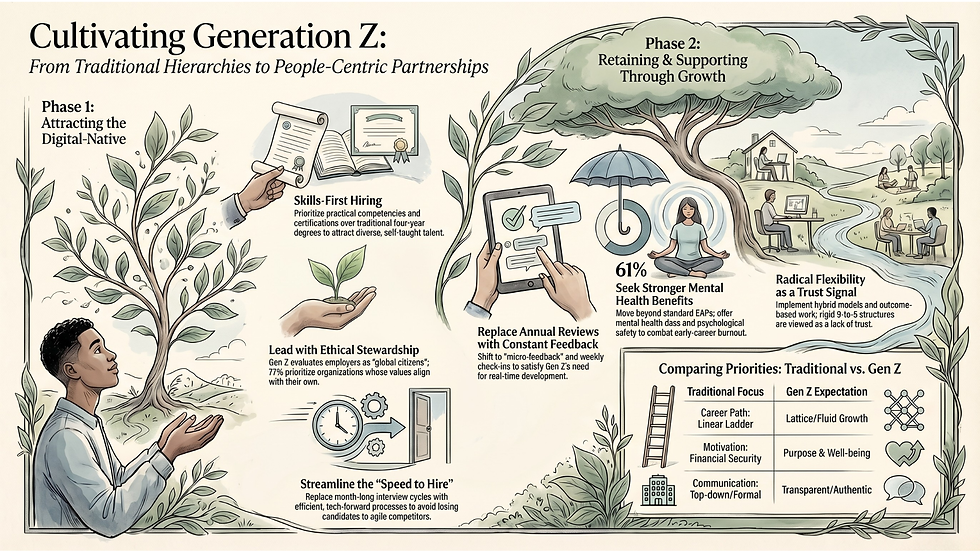
Gen Z demands Latticed Careers—non-linear movements supported by AI-driven Internal Talent Marketplaces. Stagnant roles are a death knell for retention; employees in organizations with high internal mobility stay for an average of 5.4 years, compared to just 2.9 years in traditional, rigid structures.
The strategic goal has shifted from "talent identification" to "talent activation." Consider the following ROI from early adopters:
NetApp: Navigated business transformation by inferencing 197,000 skills across their workforce in 90 days.
Schneider Electric: Unlocked 200,000 hours of productivity and saved $15 million in recruitment costs.
Mastercard: Unlocked 900,000 hours of productivity by facilitating internal movement.
Radical Authenticity: Diversity as an Organizational Health Metric
For Gen Z, diversity is no longer a metric to be tracked—it is a "watchword" for organizational health. This generation scrutinizes ethical stewardship with unprecedented intensity. Employment is now a form of "conscious consumption."
The risks of performative marketing are severe: 77% of Gen Z will refuse to work for (or buy from) companies with poor environmental track records. Furthermore, this cohort will "drag" a brand on TikTok if internal culture and DEI practices do not match external marketing. They expect brands to be "good global citizens" who apply their social responsibility internally through fair wages and inclusive leadership.
"Gen Z and ZAlpha evaluate employers on a spectrum of identity, orientation, and cognitive styles. They demand a tangible commitment to solving societal challenges, from climate change to social justice."
Bridging the Gap: The Mentorship-Coaching Reversal
Intergenerational conflict in 2026 often stems from a clash of "hierarchical" vs. "mentoring" styles. While Boomers and Gen X may favor traditional command structures, Gen Z and ZAlpha gravitate toward authentic, coaching-focused leadership.
To maintain wellbeing, organizations must foster social support and resilience—the two primary internal factors that protect Gen Z from the psychological distress of the digital age. Frame your engagement strategy around the 6 Pillars of Engagement (Extended Self-Determination Theory), which serve as your primary Retention Levers:
Autonomy: The primary predictor of retention; providing flexible pathways and self-reliance.
Purpose: A top predictor of happiness; ensuring work contributes to societal ethics.
Competence: Mastery via precision skilling and "flow state" matching.
Relatedness: Fostering connection through peer-to-peer mentoring.
Flow: Balancing individual skills against perfectly calibrated challenges.
Achievement: Facilitating higher levels of self-actualization.
Conclusion: The Human-Machine Synthesis
The successful organization of 2026 has moved from the "governance of courses" to the "activation of talent." Technology must be used to enrich learning and amplify human agency, not to replace cognitive effort. As the oldest ZAlphas enter your workforce with their hybrid, AI-absorbed worldview, the ultimate competitive advantage will be your ability to provide a place of purpose.
Is your organization currently a place that manages tasks, or one that activates human potential?
Works Cited
"After Gen Z | Meaning and Age Range of Generation Z & Generation Alpha," Maarten Leyts.
"Conflict Management Strategies Between Generations in the Workplace," Ade Suhara et al., The Journal of Academic Science.
"Future of Work: Engage Gen Z in 2026 with Learning Ecosystems," TechClass.
"Generational Differences in the Workplace," TriNet.
"Internal and external factors influencing Gen Z wellbeing," Diena Dwidienawati et al., PMC.
"McCrindle x Pew x iGen," r/generationology.
"OECD Digital Education Outlook 2026."
"REPORT: Creation gaming unlocks learning for Gen Alpha," Kidscreen.
"Report: Gen Z's Purchasing Behavior and Cultural Influence in 2025."
"The Emerging Behavioral Blueprint of Gen Alpha," Greenbook.


Comments