
The Authenticity Audit: 5 Reasons Gen Z is Rewriting the Social Contract with Brands

Published 4/12/2026
The legacy of the global pandemic has left a profound trust deficit in its wake, characterized by eroded institutional trust and a move toward radical skepticism. For stakeholders, this presents a high-stakes paradox: just as corporate motives are being viewed with unprecedented doubt, Generation Z is ascending as the ultimate economic arbiter, wielding over $360 billion in global spending power.
Our audit reveals that for this demographic—and the hyper-digital "ZAlpha" micro-generation (born 2006–2012) currently following them—the relationship with brands has shifted from a transaction to a manifesto. To survive this transition, brand leaders must recognize that authenticity is no longer a marketing "value-add"; it is the core of the new social contract.

Purpose Over Product (The Ethical Mandate)
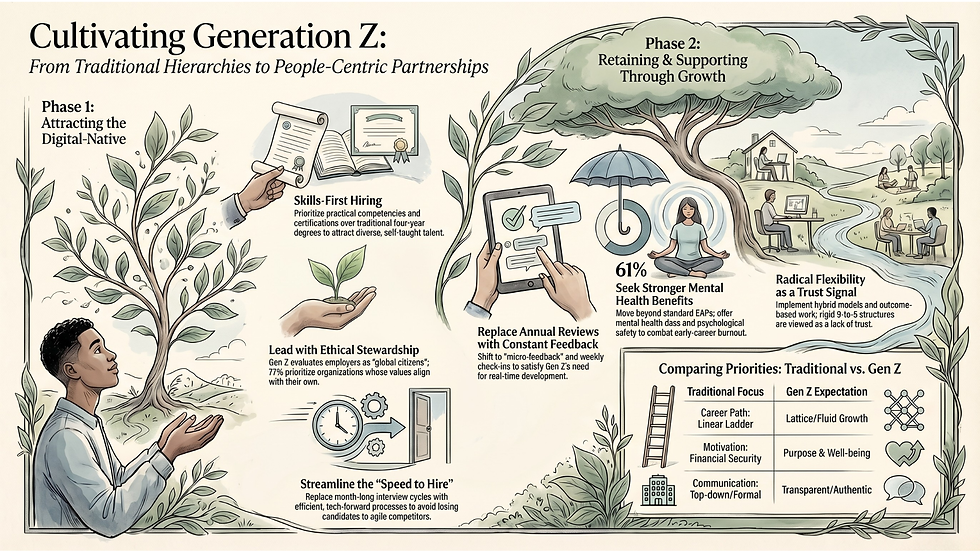
For Gen Z and the emerging ZAlphas, consumption is an act of "conscious consumption" where every purchase serves as a vote for a specific worldview. Our findings dismiss the notion that this is a niche concern; data indicates that 77% of Gen Z consumers will refuse to buy from companies with poor environmental track records.
Brand leaders must audit their presence across the "spectrum of differences," ensuring they align with this generation's values regarding identity, cognitive styles, and social justice. This cohort views their professional and consumer lives through a "sense of mission" rather than a linear career or shopping list. As the TechClass insights confirm:
"Their loyalty is not given by default. It is earned through an organization's commitment to social justice, environmental sustainability, and personal growth."
The Death of Blind Brand Loyalty
The era of the "legacy brand" is effectively over. The 2025 Gen Z Purchasing Behavior Report reveals that 57% of Gen Z are less loyal to brands now than they were in the pre-pandemic era. Loyalty is no longer an inherited trait; it is a conditional asset that must be re-earned daily.
A critical and often overlooked driver of this churn is the "boredom factor." Approximately 43% of U.S. Gen Zers have abandoned a once-favored brand simply because they grew bored with its content or felt it lacked "cool," creative marketing. This boredom is directly tied to the "8-second filter"—a cognitive defense mechanism that discards any content failing to prove immediate relevance. To bridge this gap, brands must pivot from static messaging to constant innovation and value alignment.
Radical Transparency vs. "Greenwashing"
Gen Z’s demand for Environmental, Social, and Governance (ESG) accountability has matured beyond slogans. While these consumers are willing to pay a "Green Premium" of up to 10% more for eco-friendly goods, they are highly attuned to "superficial ethics." Our audit shows that 58% of Gen Z are wary of brands that claim sustainability without verifiable proof.
To establish true credibility, brands must demonstrate their values internally before marketing them externally. Strategic leaders are utilizing Internal Talent Marketplaces—as seen at Schneider Electric ($15 million in savings) and Mastercard (900,000 hours of productivity unlocked)—to prove their commitment to social justice and employee growth.
Superficial Marketing (Greenwashing) | Transparent ESG Practice |
Claiming sustainability without verifiable proof | Publicly researching and reporting environmental/social impact |
Using tokenism or "purpose" as a marketing gimmick | Integrating CSR into the core business mission |
Ignoring the supply chain's ethical footprint | Actively auditing and correcting labor/environmental abuses |
The Peer Truth (UGC as the Ultimate Vetting Tool)
In a world of deepfakes and AI-generated "workslop," Gen Z leverages user-generated content (UGC) as their primary vetting tool. Peer validation via TikTok and Reddit has become a prerequisite to purchase, largely because it bypasses the polished artifice of traditional advertising.
The data is clear: 84% of Gen Z trust a brand more when they see actual customers featured in ads rather than professional models. They are not looking for perfection; they are looking for signs of credibility.
"Gen Z trusts influencers and peers more than traditional advertisements. They look for signs of credibility like authenticity, expertise, or a loyal follower community."
Navigating the AI Paradox: The Human Premium
Despite being digital natives, Gen Z is experiencing a "Self-Preservation" culture driven by significant AI anxiety. Approximately 40% of younger workers report stress over job security due to generative intelligence, leading to a surprising pivot toward "AI-proof" stability.
We are seeing a massive shift toward careers that require physical presence and deep empathy—such as skilled trades, healthcare, and education—with 62% of workers expressing interest in trades for better stability. For brands, this identifies a strategic opportunity to fulfill the "Relatedness" and "Autonomy" needs identified in Self-Determination Theory. In an era of automated "workslop," the brand that provides authentic human connection and positions itself as a partner in the "Agentic Workforce" will command the highest premium.
Conclusion: The Future of the Human-Machine Synthesis
The organizational landscape is undergoing a Great Reconfiguration. We are moving from the governance of courses to the activation of talent, and from transactional management to authentic mentoring. As technology increasingly replicates the "what" of your business, your survival depends entirely on the "why."
In an era where technology can replicate almost anything, is your brand's human purpose its only truly inimitable asset?
Works Cited
Generation ZALPHA. (2024). After Gen Z | Meaning and Age Range of Generation Z & Generation Alpha. https://www.generationzalpha.com
The Journal of Academic Science. (2025). Conflict Management Strategies Between Generations in the Workplace. https://doi.org/10.59613/jvggv153
TechClass. (2026). Future of Work: Engage Gen Z in 2026 with Learning Ecosystems. https://www.techclass.com
TriNet. (2026). Generational Differences in the Workplace: Boomers, Gen X, Gen Y, and Gen Z Explained. https://www.trinet.com
PMC - NIH. (2025). Internal and external factors influencing Gen Z wellbeing. https://pmc.ncbi.nlm.nih.gov/articles/PMC12042498/
OECD. (2026). OECD Digital Education Outlook 2026: Exploring Effective Uses of Generative AI in Education. https://doi.org/10.1787/062a7394-en
Kidscreen. (2024). REPORT: Creation gaming unlocks learning for Gen Alpha. https://kidscreen.com
Greenbook. (2025). The Emerging Behavioral Blueprint of Gen Alpha. https://www.greenbook.org


Comments