
Why Your Neighborhood is the Secret Weapon Against Dictators: 5 Truths About Scarcity and Power

Published 3/19/2026
We often treat the rise of the political "strongman" as a failure of education or a shift in abstract ideology. But as a social psychologist and policy analyst, I look at the data and see something far more primal. Authoritarianism is not just a choice made at the ballot box; it is a physiological and psychological retreat—a "physiological flight" triggered when the foundation of our daily lives, particularly our housing and economic stability, begins to crack.
When your rent is too high and your future feels unbankable, your brain doesn't look for a policy white paper. It looks for a protector. To save democracy, we have to understand the "scarcity mindset" and why a stable neighborhood is the best strategic defense we have against the erosion of freedom.

Scarcity is a Biological Hijack of the Brain
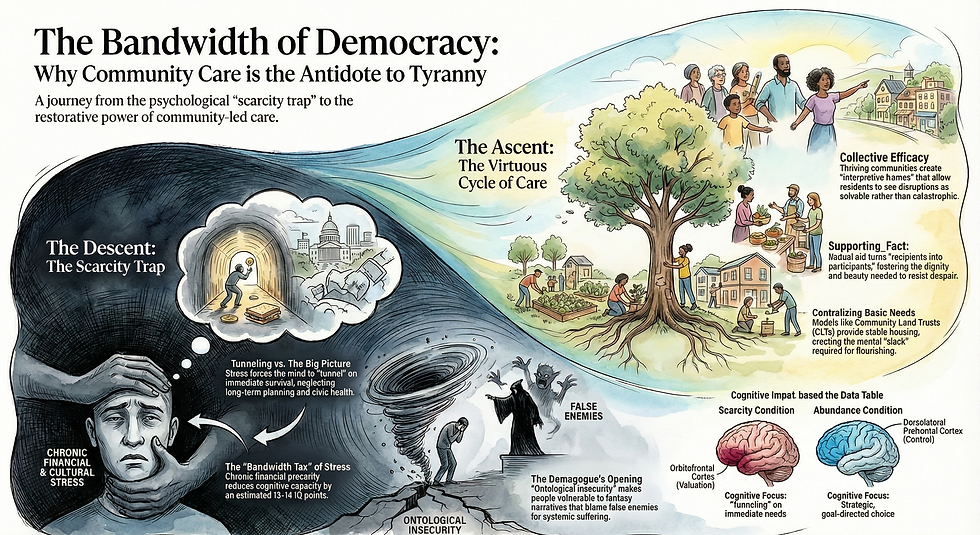
The feeling of "not having enough" reconfigures your neural architecture. Research from Radboud University shows that scarcity creates a specific "neural locus" that shifts how we process the world. Using fMRI data, researchers found that scarcity triggers increased activity in the orbitofrontal cortex (OFC)—the region responsible for valuation and immediate reward—while simultaneously decreasing activity in the dorsolateral prefrontal cortex (dlPFC), the center for complex planning and goal-directed choice.
Crucially, the study identifies an "order effect": the biological trigger is most potent when we move from abundance to precarity. This transition forces an obsessive focus on immediate resources at the cost of long-term attention. This is how demagogues win; they exploit a brain that has been biologically rewired by scarcity to favor immediate, simplistic promises over the complex cooperation required for a healthy democracy.
"The experience of insufficient resources can create a 'scarcity' mindset; increasing attention toward the scarce resource itself, but at the cost of attention for unrelated aspects."
The "Dangerous Worldview" and the Fragility of Order
Economic crises and low socioeconomic status (SES) don't just limit your bank account; they build a "Dangerous Worldview." According to the Dual-Process Model, economic threat activates a structural perception that the world is a predatory place and that the "social order is fragile."
This cocktail consists of two mechanisms: a perception of the world as threatening and a total loss of perceived sociopolitical control. When people feel they can no longer influence the systems meant to protect them, they gravitate toward authoritarian leaders. This isn't about the left or the right; it is about a desperate search for a leader who adopts a "command-and-control" style to fix perceived chaos. The neighborhood, then, becomes the front line. If the neighborhood is stable, the worldview remains secure.
Fleeing from Freedom: Why Isolation Breeds Submission
Social philosopher Erich Fromm identified an "existential tension" in modern life. We have "freedom from" external masters, but we often lack the "freedom to" realize our authentic selves. To be psychologically whole, Fromm argued humans have five fundamental needs: Relatedness, Transcendence, Rootedness, Identity, and a Frame of Orientation.
When a modern economy leaves a population "unbankable" and isolated, the anxiety of being unsupported becomes unbearable. People then adopt escape mechanisms to resolve the tension:
Authoritarianism: Fusing the self with a powerful leader or institution.
Destructiveness: Tearing down systems that cause pain.
Automaton Conformity: Dissolving into the crowd—or the "digital herd"—adopting pseudo-thoughts to avoid individual responsibility.
When you can’t participate in the economy, you "flee" into the strength of the group. Stable community structures fulfill those needs for Rootedness and Identity, making the "herd identity" of authoritarianism unnecessary.
Shared Equity Housing as a "Stability Vaccine"
If scarcity is the virus, models like Community Land Trusts (CLTs) and Limited Equity Cooperatives (LECs) are the stability vaccine. These are not mere "landlord-tenant" arrangements; they are a subversive non-market ideology that protects the brain's dlPFC from the scarcity hijack.
While CLTs often require conventionally "bankable" households to secure mortgages for the structure while the trust holds the land title via permanent affordability covenants, LECs offer a solution for the "unbankable." Through blanket project financing, residents pool resources to own shares in a cooperative, providing autonomy for those otherwise excluded from ownership.
These models improve health through three key mechanisms:
Stress Reduction: Resale formulas prevent speculative price hikes, ensuring a permanent "financial cushion."
Housing Quality and Amenities: Beyond air quality, these models prioritize "Theme 3" mechanisms: neighborhood walkability, green space, and proximity to health-promoting services.
Social Feasibility: Success depends on resident-led organizing and education, which transforms the "renter psychology" into an "owner psychology."
Social Capital: The "Superglue" and "Scaffold" of Democracy
Resilience is built on Social Capital, which serves as the "superglue" and "lubricant" of our social fabric. When these networks are strong, they fulfill Fromm’s needs for Relatedness and Rootedness, providing the psychological security that prevents "physiological flight."
Bonding (The "Sociological Superglue"): Strong ties between similar people (family, faith groups) that provide emotional support.
Bridging (The "Lubricant"): Weak ties between different groups that ease conflict and spread information.
Linking (The "Scaffold"): Vertical connections to institutional power.
Linking capital is vital because it provides perceived sociopolitical control. When residents feel they have a direct line to local authorities and power, the "Dangerous Worldview" cannot take root. A neighborhood rich in these ties creates a population that is rooted, connected, and immune to the siren song of submission.
Conclusion: The Path Forward
Thriving, stable communities are not just a "nice-to-have" social goal; they are a strategic defense for a free society. If we allow economic precarity to continue rewiring our neural pathways toward fear and short-term survival, the rise of authoritarianism becomes a biological inevitability.
To protect our democratic resilience, we must look beyond the ballot box and into the foundation of our neighborhoods.
We must ask ourselves: If we know that financial precarity literally rewires our brains for fear, can we truly have a healthy democracy without a foundation of housing stability?

Comments