
Why Stressed Societies Seek Demagogues and the Community Model That Sets Us Free

Updated: Apr 5
Published 4/5/2026
Introduction: The High Cost of Survival Mode
Imagine the heart-pounding tally of a bank balance that doesn’t quite meet the month’s demands. It’s the mental fog of a 5:00 PM commute, shadowed by the looming threat of a layoff or a rent hike. This isn’t just "stress"; it is a systemic pressure that forces the human brain into "survival mode." As a social psychologist and systems consultant, I see this as a primary failure of our social architecture. When resources—be they financial, temporal, or cultural—feel insufficient, we fall into a "scarcity mindset."
The most dangerous byproduct of this mindset is a phenomenon called "tunneling." Our cognitive bandwidth narrows, focusing exclusively on immediate fires while neglecting long-term planning and the health of our wider community. This narrowing isn't just a personal tragedy; it is a sociopolitical liability. When individuals are caught in this downward spiral of desperation, they become neurologically primed for demagoguery. However, the solution isn't just more "resilience" on the individual level—it requires a systemic circuit breaker. We must build "scarcity-proof" communities that restore cognitive agency and set us free from the trap of authoritarianism.
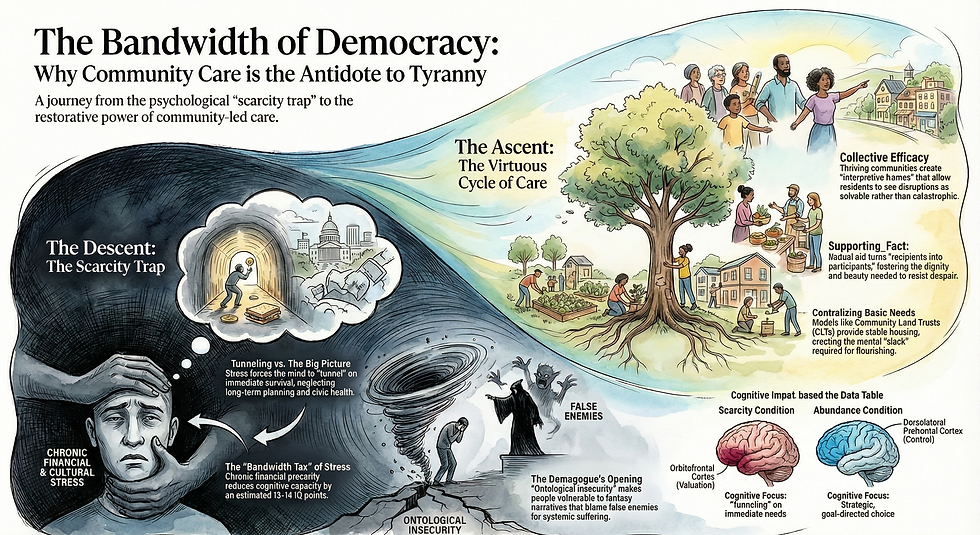
The Brain on Scarcity: How "Tunneling" Blinds Us to the Big Picture
Neurological research using fMRI, specifically the 2019 study by Huijsmans et al., reveals that scarcity is not merely a lack of resources, but a fundamental shift in brain processing. When we perceive scarcity, our internal valuation systems are hijacked.
Activity increases in the orbitofrontal cortex (OFC), which handles reward and valuation, as the brain hyper-focuses on the missing resource. Conversely, there is a marked decrease in activity in the dorsolateral prefrontal cortex (dlPFC). This is the leverage point where systems fail: the dlPFC is the "CEO" of the brain, responsible for goal-directed choice and complex executive function.
Neural Snapshot: The Scarcity Shift
Orbitofrontal Cortex (OFC): The Valuation Center. In scarcity, this region works overtime, driving an obsessive focus on immediate needs (e.g., "How do I pay rent tomorrow?").
Dorsolateral Prefrontal Cortex (dlPFC): The Planning Center. Responsible for goal-directed choices and weighing long-term consequences. In scarcity, its activity is suppressed.
The Systemic Impact: A inhibited dlPFC means individuals literally lose the cognitive capacity to "fact-check" or weigh the long-term societal consequences of a leader’s rhetoric.
Critically, this neuro-chemical shift is most jarring when transitioning from abundance to scarcity. The "pain of loss" triggers a much stronger reaction than a steady state of poverty. This explains why societies that feel they are "falling behind" or losing their status are most susceptible to the authoritarian lure.
The Authoritarian Lure: Why Stress Breeds Trust in Demagogues
The "tunneling" brain creates an opening for the "Dangerous Worldview." As highlighted by Torres-Vega et al. (2021), economic threat triggers a specific chain reaction: Economic Crisis/Low SES → Low Perceived Sociopolitical Control → Authoritarianism.
When people feel they have lost the "freedom to" influence the systems governing their lives, the anxiety of isolation becomes unbearable. Erich Fromm identified this as a psychological "escape mechanism." To find relief from the crushing weight of personal responsibility during a crisis, individuals seek "Authoritarianism"—a psychological fusion with power.
"Authoritarian submission involves a general acceptance of what is said and done by those in a position of authority and the willingness to obey the authorities without questioning them." — Torres-Vega et al., 2021
By submitting to a strong leader, the individual trades the chaos of choice for the certainty of command. Demagogues exploit this by weaponizing the "pain of loss" mentioned earlier, offering a clear enemy to blame for the transition from abundance to lack.
The Paradox of Freedom: Why We Flee into the Arms of Certainty
Fromm’s distinction between "freedom from" and "freedom to" is vital for understanding this systems-level failure. Modern society has largely achieved "freedom from" (emancipation from old constraints), but we struggle with "freedom to"—the positive use of freedom to develop an authentic self.
During systemic crises, the weight of this autonomy becomes a burden. Many choose "Automaton Conformity," dissolving into the crowd to avoid the anxiety of standing alone. In today’s context, this often manifests as adopting "culture war" slogans or rigid ideological identities. These act as a "False Map" or Frame of Orientation. Even if the demagogue’s map is objectively false or exclusionary, the tunneling brain finds it psychologically preferable to the terrifying void of having no map at all. The dlPFC’s inhibition means the individual cannot easily identify the map's flaws; they only feel the relief of its certainty.
The Antidote: Building Thriving, "Scarcity-Proof" Communities
To break this positive feedback loop of stress and authoritarianism, we must design systemic interventions that "centralize caring." The Community Land Trust (CLT) and Limited Equity Cooperative (LEC) models are high-leverage tools for this purpose.
By separating building ownership from land ownership, CLTs ensure permanent affordability. This removes housing from the speculative market—the very market that often triggers the "scarcity shift."
A crucial "systems thinking" detail found in Ehlenz’s (2014) research is how LECs solve the "bankability" problem. In a standard market, low-income or stressed individuals are often "unbankable," excluded from traditional mortgages. LECs circumvent this by utilizing a blanket mortgage for the entire cooperative corporation rather than individual mortgages. This structural design allows the most vulnerable to access ownership without the prohibitive barriers of the traditional financial system.
Furthermore, these models rely on "Social Feasibility." The resident commitment and "sweat equity" required are more than just labor; they are the foundation of community autonomy. They replace "Authoritarian submission" with a virtuous cycle of active participation.
Social Capital: The Glue, Lubricant, and Scaffold of Resilience
In any system, the most resilient assets are those that increase in value during a crisis. Unlike financial or physical capital, which break or deplete under pressure, social capital thrives on collective struggle. It is the only asset that actually increases when the system is challenged.
Type | Metaphor | Disaster Function (Jang et al., 2024) |
Bonding | Glue | Provides emotional support and immediate physical assistance within homogeneous groups. |
Bridging | Lubricant | Alleviates conflicts and diffuses information between heterogeneous groups/backgrounds. |
Linking | Scaffold | Connects people to institutional power; speeds the receipt of post-disaster aid and assistance info. |
This social capital acts as a scaffold that keeps the community upright when the economic floor drops. It prevents the "tunneling" that leads to political desperation.
Moving from "Tunneling" to "Productive Orientation"
The stability provided by CLT and LEC models is a public health intervention. By ending the "chronic low-burn stress" of housing insecurity (Rose et al., 2023), these structures allow the brain to exit survival mode.
Neurologically, this stability re-activates the dlPFC. When the brain’s goal-setting center is back online, individuals can transition from a reactive state to what Fromm calls a "Productive Orientation." This orientation is defined by Productive Love, Work, and Reason.
By re-engaging our "Reason"—the cognitive capacity to think independently and critically—we become immune to the demagogue's "False Map." Stability doesn't just provide a roof; it provides the biological conditions necessary for democratic participation. We move from merely surviving the system to actively and creatively shaping it.
Conclusion: A Question of Design
Authoritarianism is not an inevitability of human nature; it is a predictable symptom of a system that fails to meet fundamental human needs. To design a society immune to demagogues, we must design for:
Relatedness: Genuine connection vs. symbiotic dependency.
Rootedness: Feeling at home in the world.
Identity: The ability to say "I am I" without needing a herd.
Transcendence: The urge to be a creator rather than a creature.
Frame of Orientation: A map of reality grounded in reason and flourishing.
Our current structures are often designed for individual "tunneling"—maximizing speculative gain at the cost of collective bandwidth. As we look toward the future, we must ask: Are we willing to invest in the "scarcity-proof" designs that protect our neighbors' cognitive health? The answer will determine whether we remain trapped in survival mode or finally achieve the "freedom to" thrive.
Works Cited
Ehlenz, M. M. (2014). Community Land Trusts and Limited Equity Cooperatives: A Marriage of Affordable Homeownership Models? Lincoln Institute of Land Policy.
Fromm, E. (1941). Escape from Freedom. (As summarized in Source Context).
Huijsmans, I., et al. (2019). A scarcity mindset alters neural processing underlying consumer decision making. PMC.
Jang, S., et al. (2024). Social Capital Theory and Quantitative Approaches in Measurements: Disaster Literature Focus. PMC.
Rose, J., et al. (2023). Mechanisms to Improve Health Through Community Land Trusts. PMC.
Torres-Vega, L. C., et al. (2021). Dangerous Worldview and Perceived Sociopolitical Control. PMC.


Comments