
The "Grey Space" Crisis: 5 Counter-Intuitive Truths About Workplace Toxicity You’re Probably Missing

Published 3/13/2026
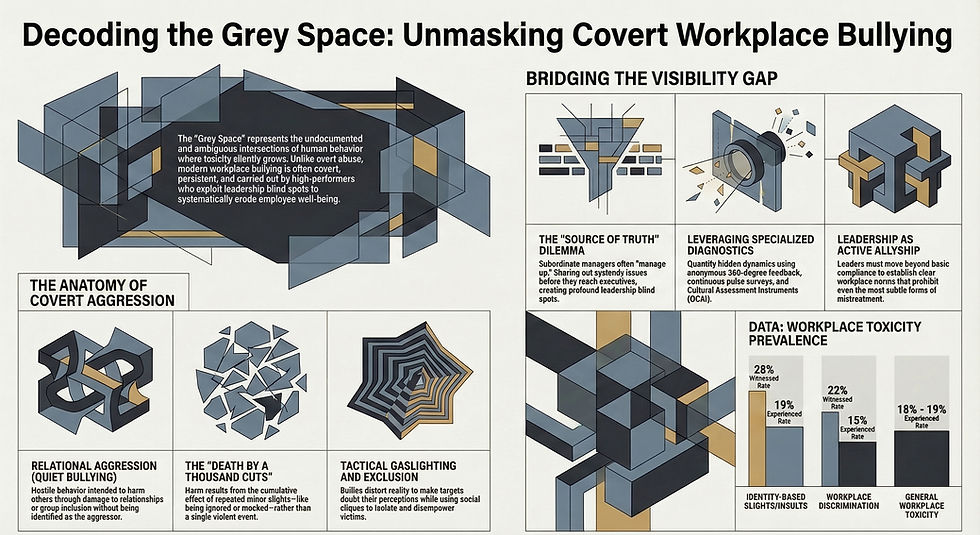
The office smells of high-end espresso and the hushed hum of designer air filtration. On the surface, the KPIs are green, the Slack channels are professional, and the "Best Places to Work" trophy sits polished in the lobby. But there is a fracture in the foundation. You can feel it in the way the energy curdles when a specific director enters the room, or in the sudden, unexplained departure of a "rockstar" developer. This is the "Grey Space"—the jagged, invisible chasm between a company’s overt HR policies and the covert, lived reality of its workforce.
While 19% of U.S. workers report being trapped in toxic cultures, the most insidious damage is done by behaviors that never reach the C-suite. In the Grey Space, toxicity isn't a loud explosion; it is a "cultural camouflage" that allows systemic rot to hide behind high performance. To dismantle it, leaders must move past the official narrative and confront five counter-intuitive truths that challenge everything they think they know about their teams.
1. Your Best "People Person" Might Be a Ghost Harasser
There is a dangerous executive fallacy: the belief that if someone is kind to you, they are kind to everyone. Investigative reality suggests the opposite. Research into the "Power Blind Spot" reveals that as leaders gain seniority, harassment doesn't disappear—it simply "evaporates" from their field of vision.
This is because harassers are master strategists. They understand that bullying is an exercise of power, and they rarely exercise it in front of those who have the authority to fire them. Instead, they deploy "calculated charisma," remaining helpful, charming, and indispensable to their superiors while targeting subordinates who lack social capital. When a victim finally speaks up, the leader often reflexively protects the perpetrator, poisoned by their own positive personal experience. This creates an environment of evaporated accountability.
"If you're in a position of power at work, you're unlikely to see workplace harassment in front of you... People who behave in those ways don't tend to do so with people they perceive as having power already." — Sarah Milstein
2. The Charisma Trap: Why "Colorful" Traits Outshine the "Bold"
Organizations consistently mistake arrogance for confidence, leading to the "Narcissistic Emergence" trap—where the most self-serving individuals are the most likely to be promoted. However, when we look at the Hogan Development Survey (HDS) data, a startling contradiction emerges.
Research by Khoo & Burch (2008) reveals that the "Bold" dimension (associated with narcissism and entitlement) is actually a negative predictor of transformational leadership. These leaders eventually "hog honors" and devalue subordinates to inflate their own status. Conversely, the "Colorful" (histrionic) dimension—characterized by being expressive and attention-seeking—was found to be a positive predictor of transformational leadership.
The investigative truth? We are hiring for "Boldness" but we should be looking for the "Colorful" ability to engage. When we choose the Bold, we install leaders who prioritize their own "superior vision" over the collective intelligence of the team, eventually destroying the Leader-Member Exchange (LMX) and driving turnover. But once these narcissistic architects are installed, they don’t just hog honors; they begin to warp the very perception of reality for those beneath them.
3. The Gaslighting & Burnout "Grey Zone"
Workplace toxicity is rarely a physical blow; it is a slow erosion of the employee’s sense of self. In the "Grey Zone," leaders utilize gaslighting—deliberately changing narratives around project expectations or feedback to cause employees to doubt their own competence. This often manifests in three distinct flavors of burnout:
Frenetic Burnout: Praising "commitment" when employees work through illness or respond to midnight emails.
Underchallenged Burnout: The soul-crushing stagnation of being bored and unsupported.
Worn-out Burnout: The inevitable result of chronic stress where even daily tasks feel like an insurmountable struggle.
The CIPD highlights a critical distinction here: the difference between Trust (an inter-group dynamic based on character) and Psychological Safety (an intra-group dynamic regarding one’s comfort in taking risks). In the Grey Space, trust is "precarious during uncertain economic times." When budgets tighten, psychological safety is the first thing to burn. Employees stop admitting mistakes not because they lack "grit," but because they no longer believe the organization will give them the benefit of the doubt.
4. The Diversity Paradox: When Identity Silos Fuel the "Oppression Olympics"
In an era of identity-focused celebrations, research from BeHealthy Counseling offers a provocative warning: segmented commemorations can unintentionally reinforce "us vs. them" mentalities. When we isolate cultural contributions into rigid silos, we risk fostering "competitive victimhood"—or what social psychologists call the "Oppression Olympics"—where groups compete for recognition rather than building solidarity.
The solution isn't to ignore diversity, but to move toward Unified Celebrations that highlight shared universal values like justice and resilience. Central to this is Psychological Flexibility—the ability to embrace multiple, overlapping aspects of one’s identity simultaneously. A culture with high psychological flexibility doesn't need to categorize humans into boxes to value them; it builds a collective narrative that is expansive rather than exclusionary. Without this flexibility, even well-intended autonomy can transform into a crushing weight.
5. The Remote Work Paradox: Engaged but Isolated
The modern workforce is living through a statistical contradiction. According to Gallup, fully remote workers are the most engaged (31%), likely due to the high autonomy that allows them to reach a "flow state." Yet, they are the least likely to be thriving (36%).
The data is stark: remote workers experience significantly higher levels of anger (25%), sadness (30%), and loneliness (27%) than their on-site peers. In the remote world, physical distance quickly becomes mental distance. Autonomy, once a perk, becomes a "cognitive burden" as the social support of office "storytelling" and camaraderie vanishes.
The business case for fixing this is undeniable. Gallup finds that 57% of remote workers are looking for new jobs. However, that number plummets to 38% when those workers are both engaged and thriving. Toxicity in a remote environment is harder to see because it hides in the silence of a closed laptop; by the time you notice the distress, the employee is already halfway through an exit interview.
"Physical distance often transforms into mental distance... Isolation can increase loneliness and, in the absence of social support, contribute to sadness and anger." — Ryan Pendell, Gallup
Conclusion: Shifting the Lens from "Sharp Eyes" to "Open Ears"
To bridge the Grey Space, leaders must accept a humbling reality: your own observations are a flawed diagnostic tool. Harassment and toxicity are designed to stay hidden from power. If you are waiting to "see" the problem before you act, you have already lost the battle.
The mandate for modern leadership is to move past "sharp eyes" and cultivate "open ears." This requires radical trust channels: skip-level meetings, 1:1 relationships outside your direct reporting chain, and a commitment to believing the stories of marginalized people over your own experience.
Stop punishing questions and start embracing mistakes as the primary data points for a learning organization. If you want a healthy culture, you must be willing to hear the truths that your title usually prevents you from seeing.
If your top performers were suffering in silence, would your current culture allow you to hear them, or are you only seeing the version of them that suits your title?
Sources Cited
Wellhub Editorial Team, "12 Signs of a Toxic Work Environment [Quiz]" (2025).
Ryan Bullard, BeHealthy Counseling, "Breaking the Divide: Why 'Us vs. Them' Hurts Unity" (2025).
Khoo & Burch, "The 'dark side' of leadership personality and transformational leadership" (2008).
CIPD, "Trust and psychological safety: An evidence review" (2024).
Sarah Milstein, LeadDev, "Why leaders can't see workplace harassment" (2022).
Ryan Pendell, Gallup, "The Remote Work Paradox: Higher Engagement, Lower Wellbeing" (2025).


Comments